

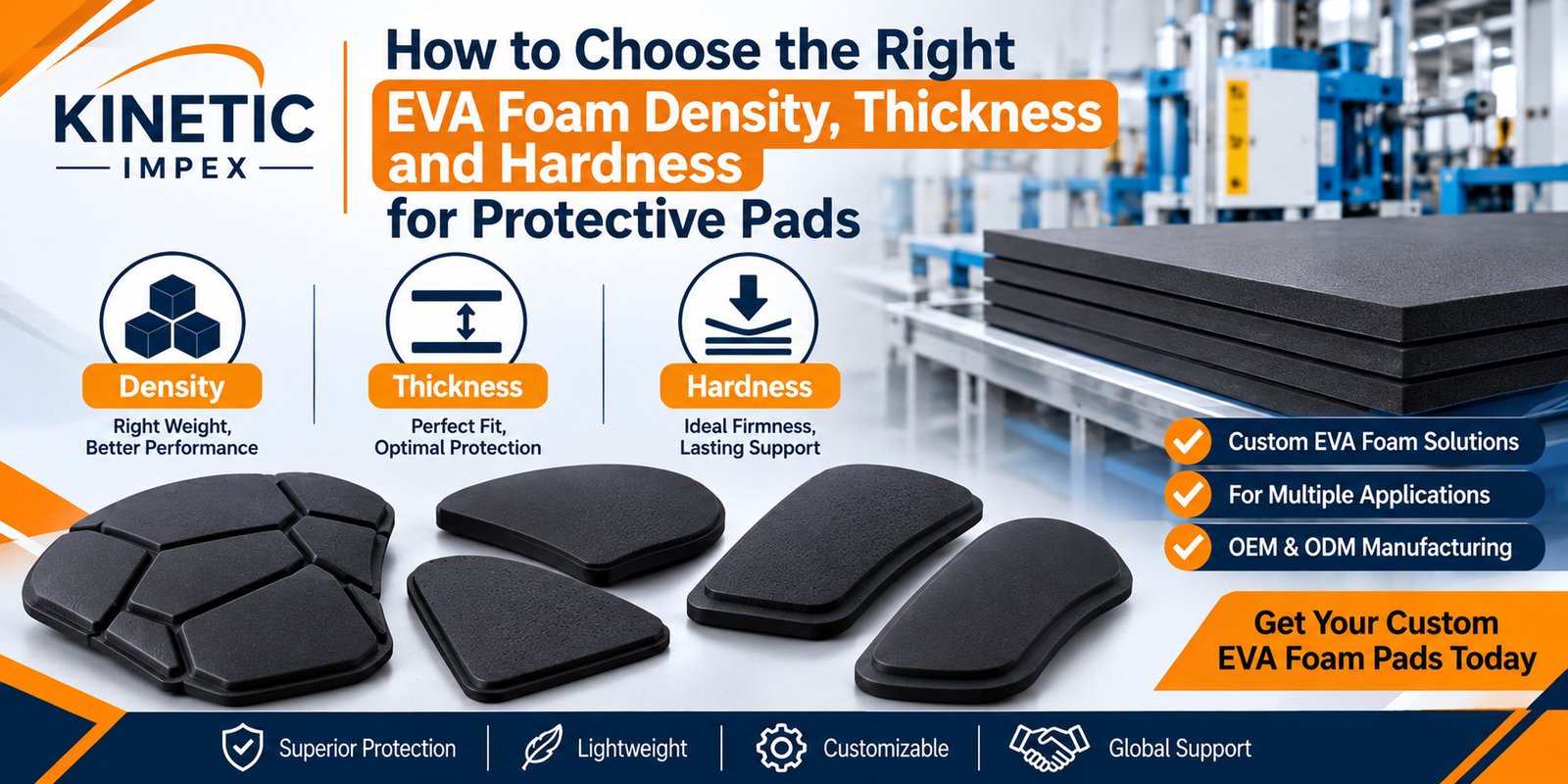
Choosing the right EVA foam is an important part of manufacturing reliable protective pads. The material’s density, thickness and hardness can influence its weight, flexibility, comfort, shape retention and suitability for different applications.
However, selecting EVA foam is not simply about choosing the thickest or hardest option. The right specification depends on how the protective pad will be used, where it will be positioned, and what level of flexibility and support the finished product requires.
In this guide, we explain how EVA foam density, thickness and hardness work, what makes them different, and how manufacturers can select suitable material specifications for custom protective pads.
1. Understanding EVA Foam for Protective Pads
Ethylene-vinyl acetate (EVA) foam is a flexible, lightweight material used in various protective and cushioning applications. Its properties can be adjusted through material formulation and processing to meet different product requirements.
EVA foam is commonly used in:
- Motorcycle jacket and suit protectors
- Sportswear protective pads
- Football and soccer protective equipment
- Cycling and biking protection
- Helmet padding and cushioning
- Industrial and workwear protective components
- Custom foam inserts and protective assemblies
For manufacturers, selecting the right EVA foam specification is essential because different applications require different combinations of flexibility, cushioning, thickness, weight and shape retention.
2. What Is EVA Foam Density?
EVA foam density describes how much material is contained within a given volume. It is commonly expressed in kilograms per cubic metre (kg/m³).
Density is an important specification because it helps manufacturers understand the material’s overall structure and weight.
How Density Affects EVA Foam
Depending on the formulation and manufacturing process, density can influence:
- Overall material weight
- Foam structure and feel
- Compression behaviour
- Support and cushioning characteristics
- Shape retention
- Suitability for different product designs
A higher-density EVA foam generally contains more material per unit volume than a lower-density option. However, higher density does not automatically mean better protection or greater hardness.
Two EVA foam materials can have similar densities but noticeably different hardness and compression characteristics.
How to Select the Right Density
The suitable density depends on the intended application and required material performance.
For example:
- Lightweight sportswear: Material weight and flexibility may be important considerations.
- Motorcycle protective gear: The material should be evaluated for its required shape, fit, compression behaviour and intended protective application.
- Cushioning applications: Compression and comfort requirements may influence material selection.
- Custom foam inserts: Density should be selected according to the product structure and the required fit.
The final choice should be based on physical material samples and application-specific testing rather than density alone.
3. What Is EVA Foam Thickness?
EVA foam thickness refers to the distance between the material’s two outer surfaces. It is usually measured in millimetres (mm).
Thickness directly affects the dimensions and construction of a finished protective pad. It can also influence the product’s cushioning, flexibility, weight and fit.
How Thickness Affects Protective Pads
Different thicknesses may be suitable for different product designs.
Thinner EVA Foam
Thinner material may be useful when:
- The product requires a low-profile design.
- Space inside a garment or protective component is limited.
- Flexibility and close body fit are important.
- The pad needs to fit within a specific garment construction.
Thicker EVA Foam
Thicker material may be considered when:
- The design requires additional cushioning volume.
- The product needs a particular shape or profile.
- More material depth is required for the intended construction.
- The pad must fit a larger product cavity or assembly.
More thickness does not automatically guarantee better protection. A thicker pad may also affect flexibility, weight, fit and movement.
Selecting Thickness for Custom EVA Foam Pads
Before choosing thickness, manufacturers should consider:
- The available space inside the finished product.
- The required pad shape and dimensions.
- How the pad will be attached or assembled.
- The desired flexibility and comfort.
- The intended application and testing requirements.
For OEM and ODM projects, thickness should be confirmed during sample development so the customer can evaluate the actual product fit and feel.
4. What Is EVA Foam Hardness?
EVA foam hardness describes how resistant the material is to indentation or surface deformation under a specified test method.
Hardness is commonly measured using a durometer. Depending on the material and testing requirements, manufacturers may use Shore A or Shore C scales.
The selected scale and test method should always be stated when comparing hardness values. Shore A and Shore C readings are not directly interchangeable.
How Hardness Affects EVA Foam Pads
Hardness can influence:
- Surface firmness
- Flexibility
- Compression under pressure
- Overall feel
- Comfort during use
- Suitability for a particular product design
Softer EVA Foam
Softer material may be considered for applications where flexibility, cushioning and a softer feel are priorities.
Firmer EVA Foam
Firmer material may be considered when a design requires greater resistance to indentation or a more supportive feel.
The correct hardness depends on the product’s construction and intended use. A harder material is not automatically safer or more protective.
5. EVA Foam Density vs Thickness vs Hardness
Density, thickness and hardness are three different specifications. They should be evaluated together, but one should not be used as a substitute for another.
| Specification | What It Measures | Why It Matters |
|---|---|---|
| Density | Mass per unit volume | Helps describe material structure and weight |
| Thickness | Material depth | Influences pad dimensions, profile and fit |
| Hardness | Resistance to indentation | Influences firmness and material feel |
For example, two EVA foam pads may have the same thickness but different densities. They may also have similar density values but different hardness readings.
This is why manufacturers should review the complete material specification before approving an EVA foam option.
6. How to Choose EVA Foam Specifications for Different Applications
There is no single EVA foam specification suitable for every protective product. The selection process should begin with the application and product requirements.
Motorcycle Protective Gear
Motorcycle jacket and suit protectors may require a specific balance of flexibility, fit, thickness and material behaviour.
Important considerations include:
- Shoulder, elbow, back, chest and knee pad dimensions
- Garment space and attachment method
- Required flexibility during movement
- Pad shape and surface finish
- Applicable product testing and performance requirements
For motorcycle applications, material selection should be supported by appropriate testing. EVA foam density or hardness alone cannot establish a CE rating or impact-protection level.
Sportswear Protective Pads
Sportswear applications can include protective padding for football, soccer and other contact or activity-based sports.
Material selection may depend on:
- Body movement and flexibility
- Pad placement
- Garment construction
- Desired cushioning and comfort
- Product weight and thickness
The final material should be evaluated inside the intended sportswear design.
Helmet Padding
Helmet padding requires careful consideration of the complete helmet construction and its applicable safety requirements.
Factors may include:
- Available internal space
- Fit and comfort
- Material compression behaviour
- Temperature and environmental conditions
- Compatibility with the helmet structure
EVA foam should not be considered a substitute for a certified helmet impact-management system without appropriate design validation and testing.
Industrial and Workwear Protection
Industrial and workwear products may use custom EVA foam components for cushioning, padding or comfort-related applications.
The material specification should be selected according to the working environment, product design, expected use and relevant safety requirements.
7. Other Factors to Consider When Selecting EVA Foam
Density, thickness and hardness are important, but they are not the only factors that influence the finished product.
Compression Set
Compression set describes how much permanent deformation remains after a foam sample has been compressed and allowed to recover under specified test conditions.
This property can be important for products exposed to repeated compression.
Flexibility and Recovery
The material should be evaluated for how it bends and recovers after deformation. The required behaviour depends on the shape and application of the finished pad.
Temperature Resistance
Some applications involve exposure to different temperatures. Material performance should be evaluated under the expected operating conditions.
Surface Finish and Processing
EVA foam may require cutting, shaping, embossing, laminating or other finishing operations. The selected material should be compatible with the required manufacturing process.
Product Fit and Construction
The foam must fit correctly within the final product. Even a suitable material specification may not work well if the pad shape, thickness or dimensions are incorrect.
8. Why Material Samples and Testing Matter
Material specifications provide useful information, but they cannot fully describe how a finished EVA foam pad will perform in its intended product.
For this reason, sample evaluation is an important part of custom manufacturing.
A practical development process may include:
- Define product requirements: Identify the application, dimensions, shape, flexibility and construction requirements.
- Select material options: Review available EVA foam grades with different density, thickness and hardness specifications.
- Prepare samples: Produce or prepare sample pieces for evaluation.
- Evaluate physical properties: Check firmness, flexibility, weight, compression behaviour and fit.
- Review the finished design: Test the pad within the intended garment or protective product.
- Confirm specifications: Approve the material and construction before moving to bulk production.
Where a product requires a specific safety standard, the appropriate finished-product testing and certification process must also be considered.
9. Custom EVA Foam Pad Manufacturing: From Specification to Production
Custom EVA foam pad manufacturing involves more than selecting a foam sheet. The material must be converted into a component that matches the customer’s design and application requirements.
At Kinetic Impex, we support OEM and ODM manufacturing projects for custom EVA foam protective pads and related components.
Our manufacturing capabilities include:
- Custom EVA foam pad shapes and dimensions
- Different thickness and material specifications
- Cutting and shaping according to product designs
- Embossed and textured surface finishes
- Custom pad sets and configurations
- Injection-moulded plastic inserts and components
- Sample development and bulk production support
We work with customers to review their product requirements and identify suitable manufacturing options. Final material specifications are confirmed according to the project design and sample evaluation.
10. How to Choose a Reliable Custom EVA Foam Pad Manufacturer
Selecting a manufacturer is an important part of developing a consistent product.
Before starting a project, consider the following:
- Material knowledge: Can the manufacturer explain density, thickness and hardness options?
- Customization: Can they produce different shapes, sizes and configurations?
- Sample development: Can they prepare samples for review before bulk production?
- Manufacturing capabilities: Can they support the required cutting, shaping, finishing and component processes?
- Quality control: Do they have a process for checking dimensions and material specifications?
- Communication: Can they understand technical requirements and provide clear project updates?
A reliable manufacturing partner should be able to discuss the complete product requirements rather than recommending material based on a single specification.
11. Work with Kinetic Impex for Custom EVA Foam Pads
Kinetic Impex is a manufacturer of custom EVA foam protective pads and related components, supporting OEM and ODM requirements for different industries.
With manufacturing experience dating back to 2008, we work with customers on custom pad designs, product configurations, material selection and production requirements.
Our capabilities include custom EVA foam pads for motorcycle protective gear, sportswear, protective equipment and other applications, along with in-house injection-moulded plastic components.
Whether you have an existing design, a physical sample or a new product idea, our team can review your requirements and discuss suitable manufacturing options.
Looking for a custom EVA foam pad manufacturer? Contact Kinetic Impex to discuss your required dimensions, thickness, density, hardness, product application and target quantity.
Frequently Asked Questions
1. What is the best density for EVA foam protective pads?
There is no universal best density. The suitable density depends on the intended application, required weight, material structure, compression behaviour and product design. Sample evaluation is recommended before confirming the specification.
2. Does higher-density EVA foam mean better protection?
No. Higher density means more material mass per unit volume, but it does not automatically mean better impact protection. Hardness, thickness, formulation, product geometry and test results also matter.
3. What EVA foam thickness is suitable for protective pads?
The correct thickness depends on the available product space, required pad profile, fit, flexibility and intended application. It should be confirmed through product design and sample evaluation.
4. Is harder EVA foam better than softer EVA foam?
Not necessarily. Softer foam may provide a more flexible feel, while firmer foam may offer greater resistance to indentation. The right choice depends on the product’s design and performance requirements.
5. What is the difference between EVA foam density and hardness?
Density measures mass per unit volume, while hardness measures resistance to indentation under a specified test method. They describe different material properties and should be evaluated separately.
6. Can EVA foam pads be customized for different industries?
Yes. EVA foam pads can be manufactured in different shapes, sizes, thicknesses, material specifications and surface finishes for applications such as motorcycle gear, sportswear, helmets and industrial products.
7. Can Kinetic Impex manufacture custom EVA foam pads?
Kinetic Impex supports OEM and ODM manufacturing of custom EVA foam protective pads and related components. Customers can share drawings, dimensions, physical samples or product requirements for project review.
Conclusion
Choosing the right EVA foam density, thickness and hardness requires understanding the intended application and the complete product design. These specifications influence different material properties, so they should be evaluated together rather than selected independently.
For consistent custom EVA foam pad manufacturing, begin with clear product requirements, review suitable material options, evaluate physical samples and confirm the final specifications before bulk production.
Contact Kinetic Impex to discuss your custom EVA foam pad manufacturing project.

3 Comments